In the Microbiome module, users can click on the Browse section to browse the metagenomic data stored in SCIGAMA. Hovering the mouse over the Microbiome option in the home page navigation bar will display a submenu, after which clicking on Browse will take you to a new page for browsing.
Browse display options
In SCIGAMA, metagenomic data is displayed according to three screening criteria: “Time”, “Microbe”, and “Anatomical Sites of the Gut”. “Time” is divided into 15 groups based on different time points after spinal cord injury, including “Control”, “Sham”, “0 min”, “30 min”, “1 hr”, “6 hr”, “12 hr”, “1 d”, “3 d”, “5 d”, “7 d”, “14 d”, “1 m”, “2 m”, and “3 m”.

“Microbe” is divided into seven levels according to the hierarchical levels of microorganisms: kingdom, phylum, class, order, family, genus, and species.

“Anatomical Sites of the Gut” allows users to browse based on the sampling location of intestinal contents. The microorganisms in SCIGAMA primarily originate from the ileum, cecum, and colon of mice. SCIGAMA enables users to select specific regions of interest to explore microbial variations.

Presentation of results table
In SCIGAMA, we present microbial data in tabular form. The tables for “Time” and ‘Microbe’ are identical, while the table for “Anatomical Sites of the Gut” is slightly different.
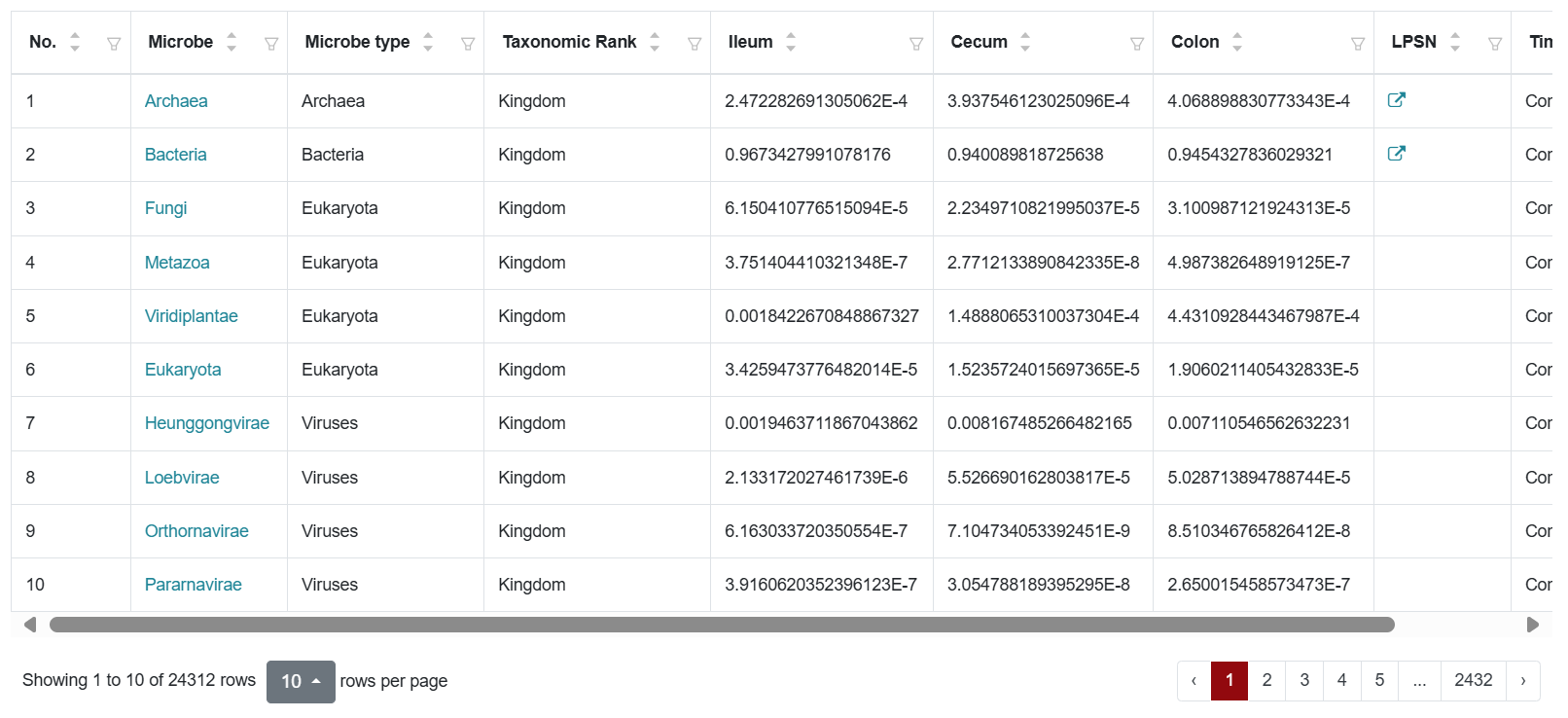
Columns and their descriptions in the results table.
| Column | Description of the column |
|---|---|
| No. | Serial number of display results. |
| Microbe | Microorganism name. |
| Microbe Type | This column shows the category of the microorganism, such as archaea or viruses. |
| Taxonomic Rank | The following column displays the taxonomic hierarchy of the microorganism.. |
| Ileum | Abundance value of the microorganism in the ileum. |
| Cecum | Abundance value of the microorganism in the cecum. |
| Colon | Abundance value of the microorganism in the colon. |
| LPSN | Click on the hyperlink to view the introduction of the microorganism in the LPSN database. |
| Time Point | Shows which time point group the microorganism belongs to. |
The results table for “Anatomical Sites of the Gut” is slightly different because the sampling sites were selected during grouping, resulting in fewer columns in the results table.
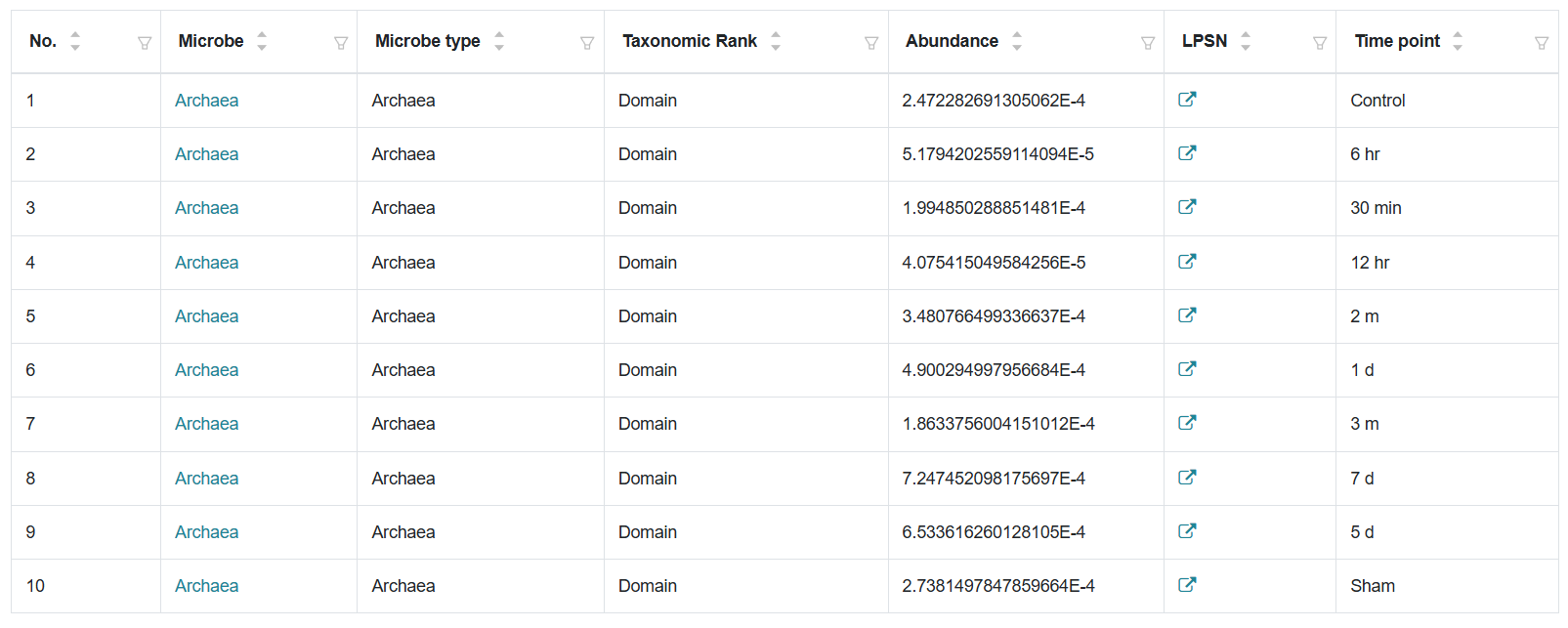
Columns and their descriptions in the results table.
| Column | Description of the column |
|---|---|
| No. | Serial number of display results. |
| Microbe | Microorganism name. |
| Microbe Type | This column shows the category of the microorganism, such as archaea or virus. |
| Taxonomic Rank | The following column displays the taxonomic hierarchy of the microorganism. |
| Abundance | Abundance value of the microorganism in that location. |
| LPSN | Click on the hyperlink to view the description of the microorganism in the LPSN database. |
| Time Point | Shows which time point group the microorganism belongs to. |